



Most teams do not need another place to ask an AI a question. They need a dependable way to run work they already repeat.
An SOP can explain how a process should work. It does not, by itself, tell an agent what this week’s task is, which inputs are current, what access is allowed, when work should stop, or who owns the outcome.
That is the gap Runlane is built to fill.
The gap
An SEO SOP might define how a page should be assessed: check intent alignment, on-page content, metadata, internal links, and the evidence behind each recommendation.
That is a good starting point. But it is not yet an operating process.
See a concrete example of turning that SEO SOP into a Runbook.
Before the work can run, someone still needs to answer:
- Which page and query are in scope today?
- What evidence is available, and what is only a guess?
- Which skills, connections, and credentials may the agent use?
- What should happen if the needed input is missing?
- Does the work run now, later, or on a schedule?
- Who decides when the result is good enough to act on?
Most teams manage those answers across documents, chat threads, task boards, and personal memory. The work may get done, but it is hard to repeat cleanly.
| Runlane object | What it holds |
|---|---|
| Runbook | The reusable procedure and its boundaries |
| Task | The current work, project context, and assigned agent |
| Run | One execution, including its output, events, and review state |
How Runlane fills the gap
Runlane turns a repetitive SOP into reviewed, scheduled task runs.
A Runbook holds the reusable procedure. A task supplies the work in front of the team now. The selected agent receives only its effective skills and chosen access. Each run has a status, output, event history, and a place for review when the agent needs a decision or more input.
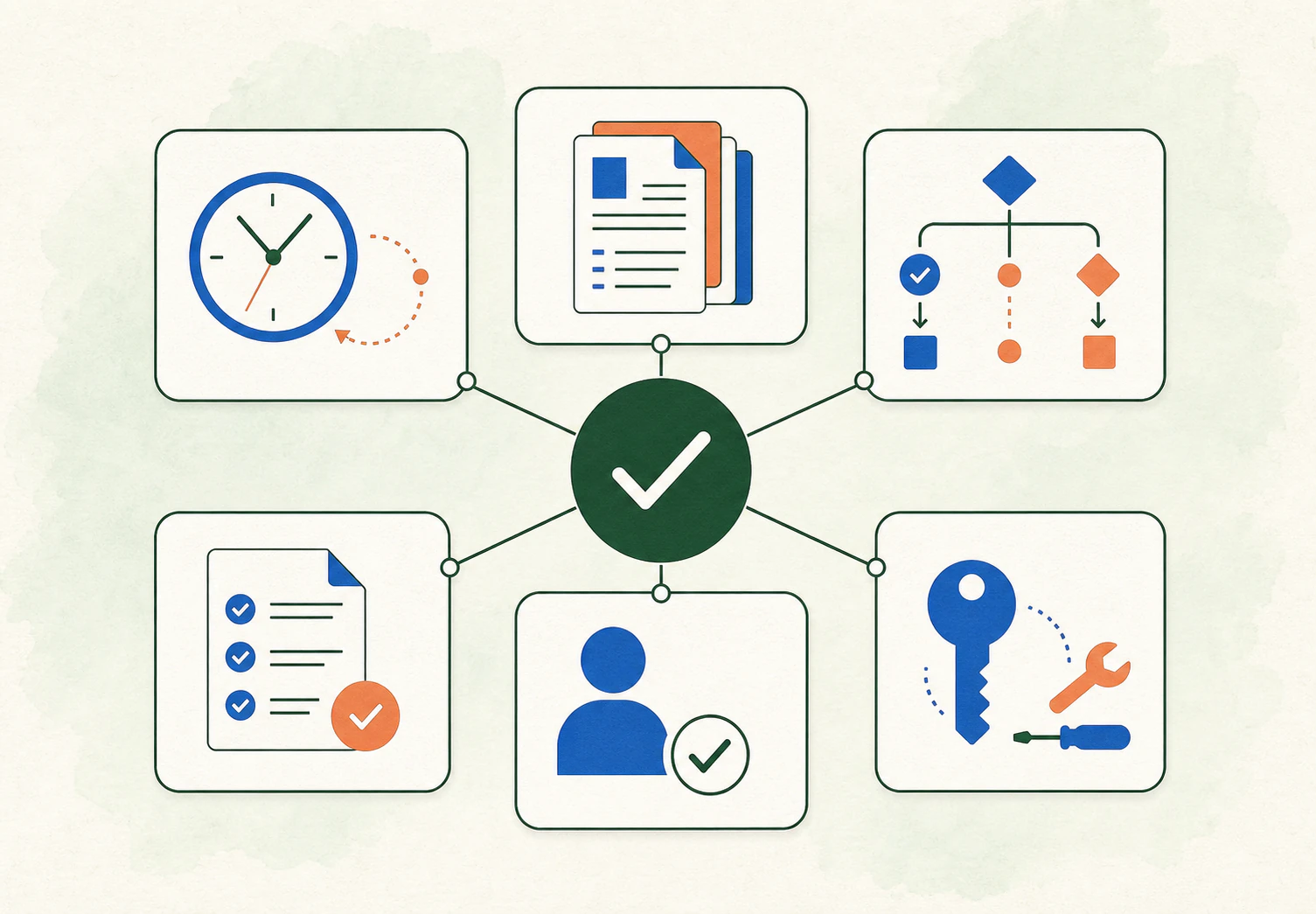
1. Trigger and schedule
Schedules should not quietly pile up duplicate work while the previous occurrence is still running or waiting for review.
Runlane keeps at most one waiting or active recurring occurrence for a task. Later occurrences are coalesced as visible skipped evidence instead of becoming a hidden backlog.
2. Relevant context
A Runbook is reusable text. A task gives it a concrete home: a project, current context, an assigned agent, a history of previous attempts, and the next piece of work to do.
The same procedure can be used again without pretending every run has the same inputs.
3. Rules and exceptions
A Runbook makes the procedure and its limits explicit, including when the agent should stop and ask for a decision or more input.
That gives the agent boundaries for the work instead of a loose instruction to do its best.
4. Tools and access
Instructions explain the job. They do not automatically grant safe access.
Before a run, Runlane shows the effective skills and selected Secrets, Variables, and connections. The agent gets the access this task needs and no more.
5. Review and ownership
An agent may need approval or input before it can continue. Runlane can pause the run, show what is being requested, and return the reviewer’s decision to the work.
Every task has an owner. That person is accountable for the outcome and is the default person Runlane notifies when a run needs review or attention. They can provide input, approve, retry, schedule, or stop the work.
Effective human review points in agentic workflows explains how to decide when a run should pause for a person.
6. Proof of completion
A finished run should leave more than a polished final answer. It should leave the output, events, status, and the decisions made along the way.
This matters when the next run needs improvement. You can see whether the issue was missing context, unclear instructions, unavailable access, a failed step, or a reviewer’s decision.
Where Runlane fits
Runlane is for repetitive, well-defined work where a team wants one place to keep the procedure, current task, controlled execution, review, and evidence together.
A good first use is narrow and reviewable: an SEO audit, a prospect research brief, a support-triage plan, or an invoice follow-up draft. Start with work where the inputs can be named, the expected result is observable, and someone can review the outcome.
SOP automation gives repeatable work a reliable place to run without taking the operator out of the loop.
Preview the Process Improvement Review Runbook or read the practical guide From SOP to Runbook.
Have a recurring process in mind? Compare plans or run it in Runlane.